
Built to spec
Built to your engineered drawings, survey, and the real site conditions, not a one-size-fits-all approach forced to fit.
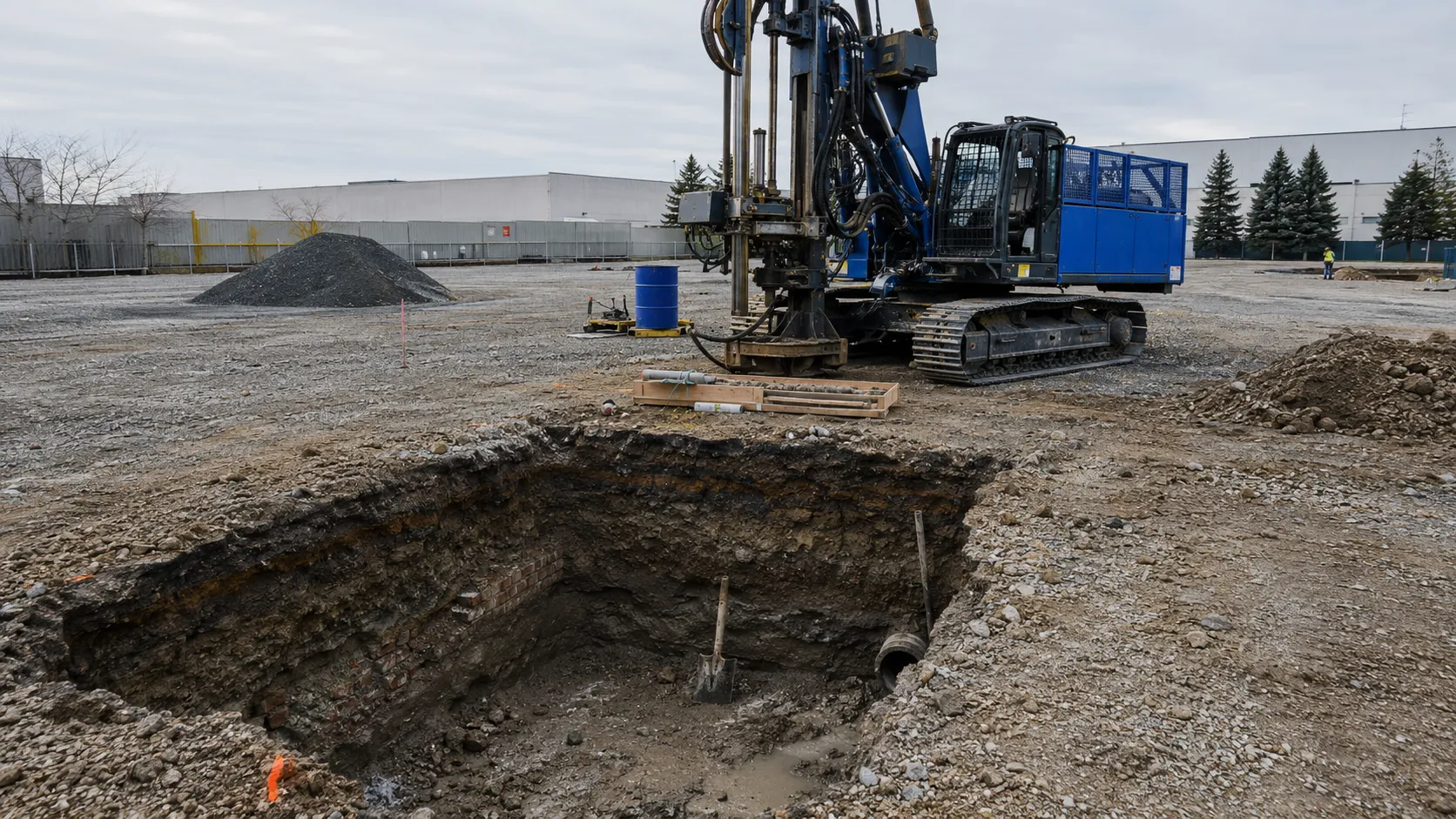
We excavate, log, sample, expose, backfill, and restore test pits for commercial, industrial, municipal, and heavy civil investigations across Toronto, the GTA, and Ontario, giving project teams direct access to shallow soil, fill, foundations, utilities, and groundwater conditions.
Tell us what you need and we’ll get you a quote. Licensed, insured & WSIB-covered · Free, no-obligation quote & on-site assessment.
Licensed, insured & WSIB-covered · Free, no-obligation quote & on-site assessment.
Built to your engineered drawings, survey, and the real site conditions, not a one-size-fits-all approach forced to fit.
Durable materials and methods chosen for the load, traffic, and environment on site.
Send specs, drawings, or photos and get a free, no-obligation site visit and estimate with no guesswork.
Installation and site work completed in accordance with Ontario requirements.
Test pits are controlled exploratory excavations that expose shallow subsurface conditions for visual logging, bulk sampling, measurements, and constructability review. Harrowgate excavates and restores test pits directly across Toronto and the GTA for geotechnical, environmental, structural, utility, pavement, and excess soil investigations.
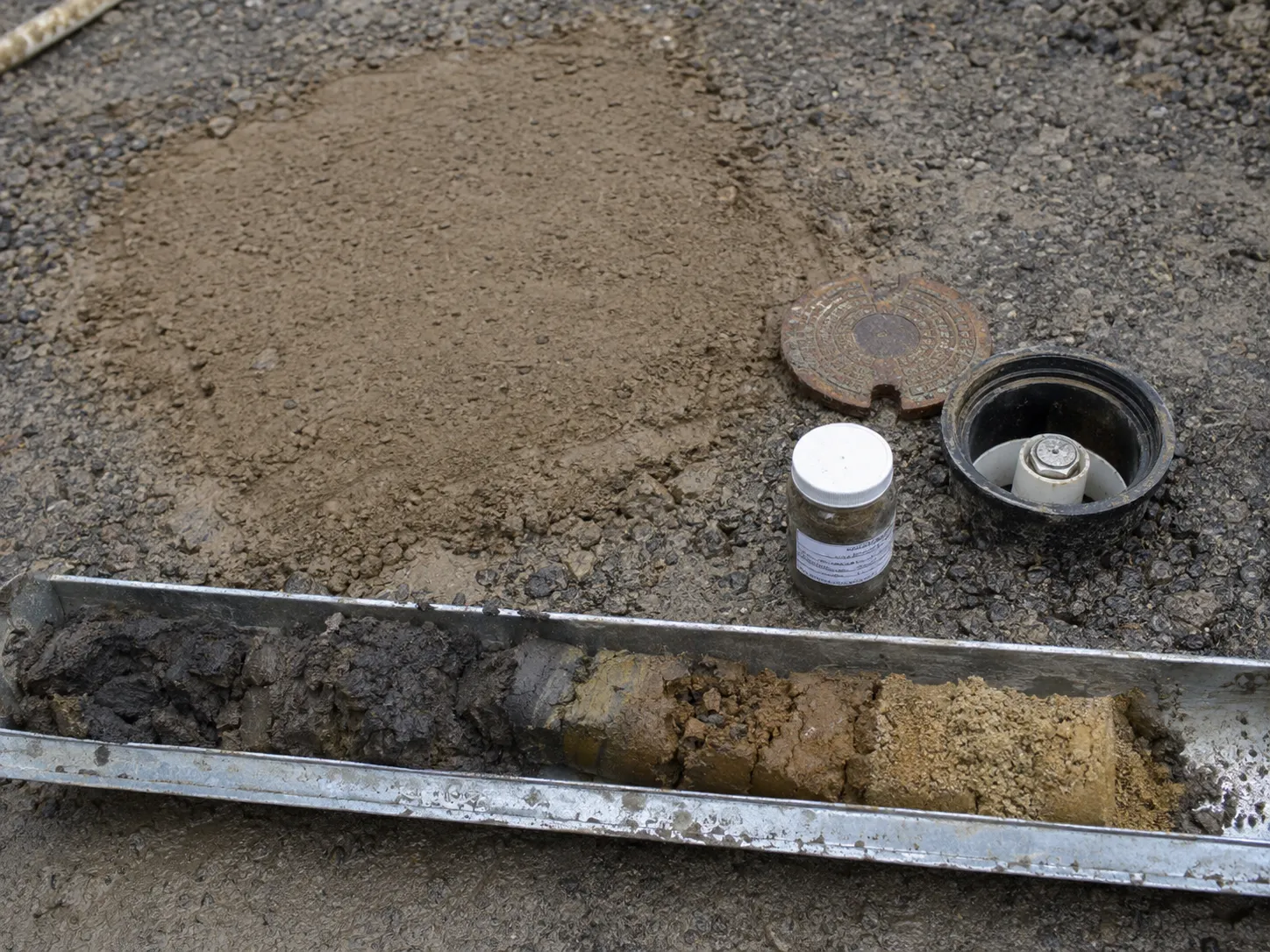
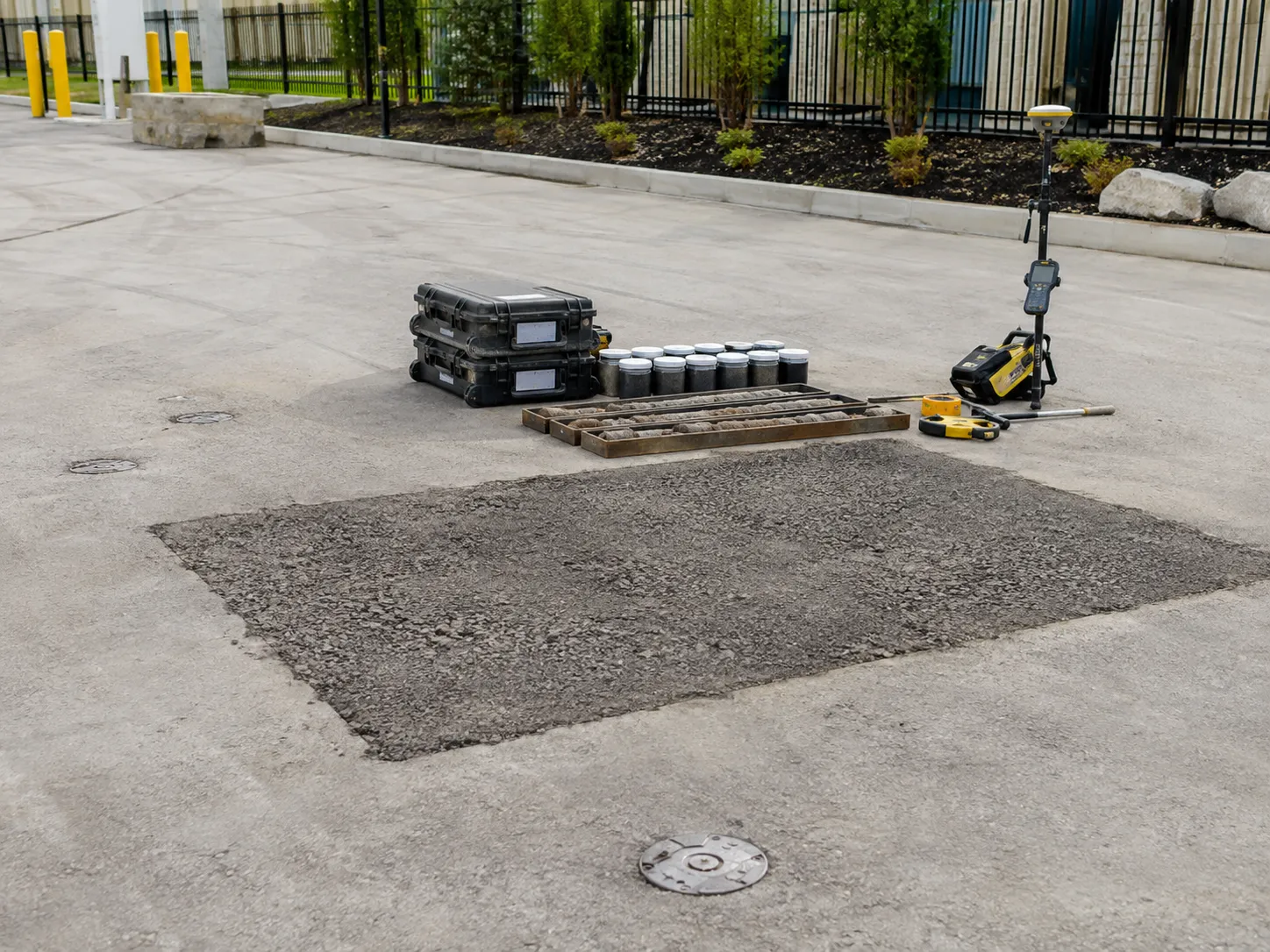
We review the investigation plan and locates, mark the excavation, establish traffic and exclusion controls, remove surface materials separately, excavate in observable lifts, place spoil in controlled zones, allow the consultant to log and sample safely, record seepage and obstructions, then backfill, compact, and restore the surface.
Nobody enters an unsupported pit. Samples and measurements are obtained from outside using the excavator bucket, remote tools, or a designed and protected excavation arrangement. The operator exposes utilities or foundations incrementally and follows the spotter’s direction. Different soil horizons, pavement, topsoil, impacted material, and debris are kept separate. Water is contained or managed under the approved plan. Before backfill, photographs capture depth, faces, samples, and features with a scale and location reference.
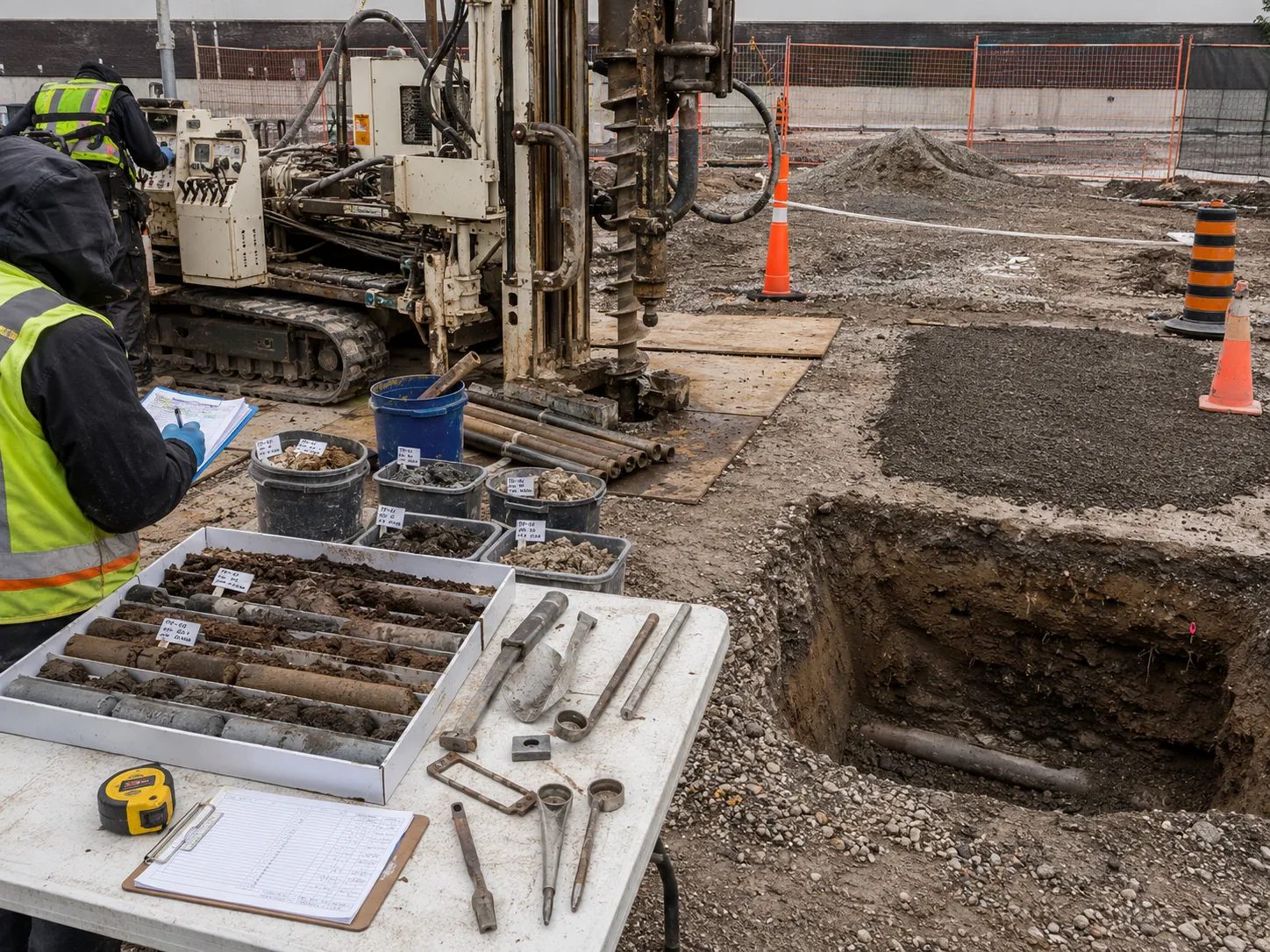
Test pits follow Ontario Regulation 213/91 excavation requirements, the engineer or qualified person’s program, O. Reg. 153/04 where the pit supports a regulated Phase Two ESA, applicable OPSS excavation and backfill provisions, utility-owner rules, excess soil requirements, and municipal permits or restoration standards.
O. Reg. 153/04 requires documentation for each test pit, including contractor, equipment, cross-contamination controls, and sample frequency. Excavation depth, soil type, water, adjacent loads, and access determine sloping, shoring, or trench-box requirements, but observation is normally performed from the surface. Public right-of-way pits require accepted traffic control and restoration. Backfill material and compaction follow the project specification, with separate treatment for pavement, concrete, topsoil, or landscaped finishes. Spoil cannot be assumed reusable until its geotechnical and environmental suitability is known.
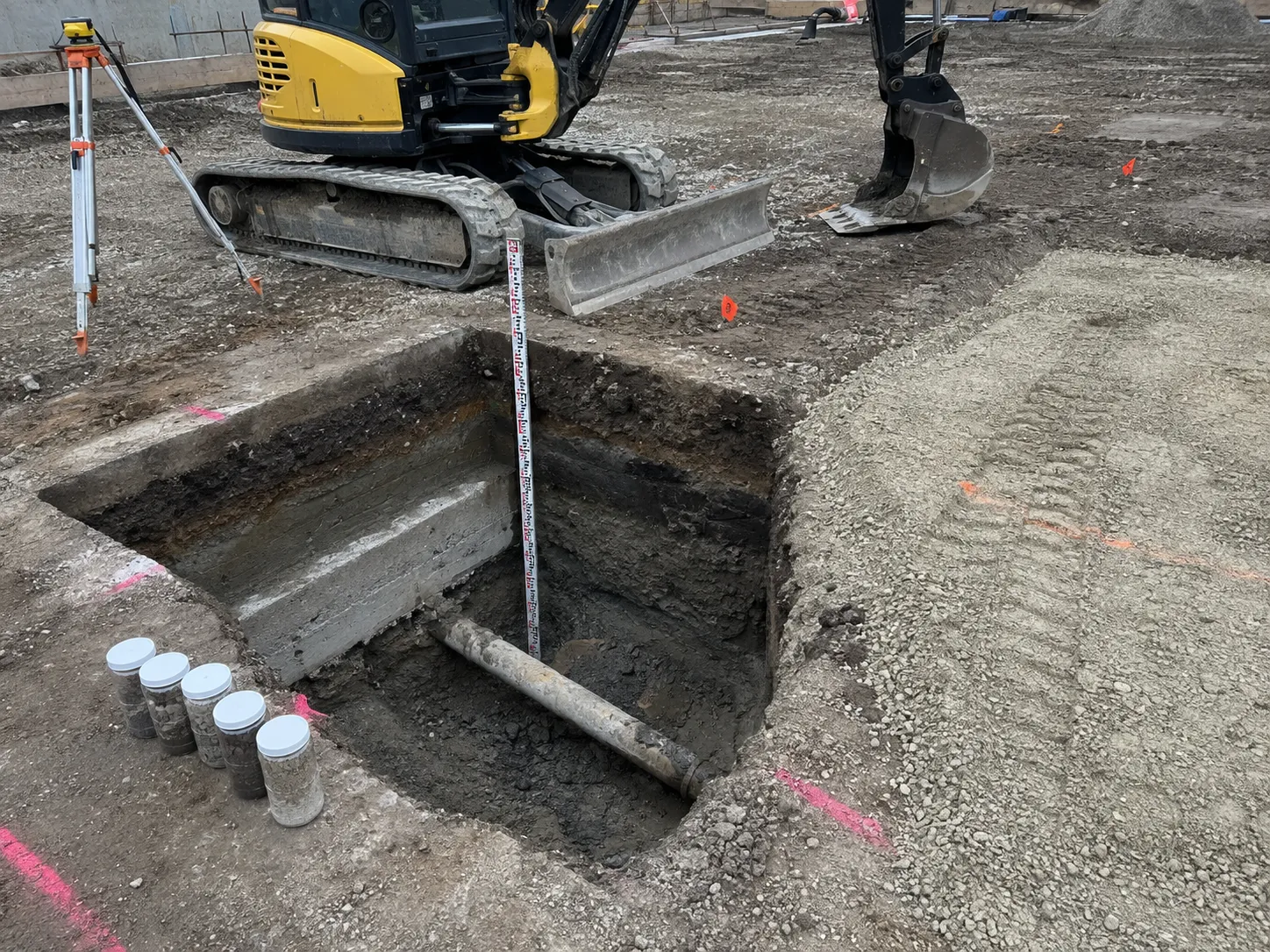
Test pits fail when utility clearance is incomplete, workers enter unsupported cuts, mixed spoil destroys sample value, seepage destabilizes the side, contaminated soil spreads, or loose backfill settles under pavement. We prevent these outcomes through incremental excavation, exclusion, segregation, consultant observation, and specified compaction.
A locate mark identifies a corridor, not exact depth, and private services or abandoned lines may be absent. We daylight carefully and stop on unknown utilities, tanks, voids, or odour. Excavated faces can change rapidly in fill, sand, or saturated soil, so no one relies on a clean-looking wall. If the pit must remain open, it receives designed support, fencing, covers, drainage, and inspection appropriate to the exposure. Most investigation pits are logged and closed the same shift to reduce risk.
Planning test pits and site investigation? Talk it through with our team.
Test pits are used to confirm footing dimensions, pavement buildup, fill thickness, buried foundations, utility depth, soil stratigraphy, boulders, topsoil, groundwater seepage, contamination, and available borrow or excess soil. They support buildings, roads, shoring, demolition, remediation, servicing, and site redevelopment.
Geotechnical programs use bulk samples and direct soil exposure where shallow variability matters. Environmental programs target staining, tanks, process areas, or fill and may collect discrete samples from the excavator bucket. Structural investigations expose existing footings for underpinning design without undermining bearing. Utility investigations verify crossings before tender or excavation. We choose test pits when lateral visibility and sample volume outweigh the disturbance, and boreholes when depth, access, or continuous support make open excavation impractical.
Have drawings for test pits and site investigation? Send them over and we will scope it.
A test pit exposes a broad face and plan area, making lateral soil changes, debris, boulders, fill structure, footing geometry, utility construction, seepage, and pavement layers directly visible. It also yields large samples. A borehole reaches greater depth with less disturbance and can support in-hole tests or monitoring wells.
Depth is limited by the investigation objective, soil, groundwater, adjacent loads, equipment reach, access, and the excavation-protection method. There is no safe universal depth. Most pits are designed for observation from the surface. Any required entry needs a compliant, specifically protected excavation and separate work plan.
Not by default. Samples are normally obtained from the excavator bucket or with remote tools while personnel remain outside the unsupported excavation. Entry is permitted only when the excavation has compliant sloping, shoring, or shielding, safe access, inspection, and all other required controls for the actual soil and depth.
We review public and private locates, records, owner knowledge, and surface evidence, then expose the area incrementally using non-destructive methods where required. Locate tolerance zones are respected. The operator and spotter stop on any unknown line, duct, concrete encasement, warning tape, or change in soil.
Only if the consultant and project requirements accept its geotechnical and environmental suitability. Soil is kept separated by horizon and contamination status during investigation. Organic soil, debris, frozen material, or impacted material may be unsuitable. Approved backfill is placed in controlled lifts and compacted to the restoration specification.
Most investigation pits are logged, sampled, photographed, and backfilled during the same shift. If a pit must remain open, it needs a planned protection system, secure fencing or covers, drainage, lighting where applicable, and competent inspection. Schedule convenience alone does not justify leaving an exposed excavation unattended.
Provide coordinates, purpose, target dimensions and depth, utility information, expected soil and groundwater, environmental sampling needs, access, spoil handling, observer availability, traffic control, and restoration standard. Existing pavement, contaminated material, shoring, dewatering, imported backfill, and compaction testing are important scope drivers.
Still have a question about test pits and site investigation? Ask our team directly.
Commercial and heavy-civil construction delivered for developers, contractors, property managers, and municipalities.
Send drawings, a site plan, or a description of the scope. Harrowgate Group is licensed, insured, and WSIB-covered.
Licensed, Insured & WSIB-Covered, work managed and documented on every job
Tell us what you need and we’ll get you a quote. Licensed, insured & WSIB-covered · Free, no-obligation quote & on-site assessment.
Harrowgate Group provides test pits and site investigation, delivered and installed with quote-ready support across Toronto and surrounding Ontario communities.
Companies We've Worked With
Harrowgate Group delivers commercial and heavy-civil construction for developers, contractors, institutions, municipalities, and property groups across Ontario.
 Popeyes
  Tim Hortons
  Subway
  University of Toronto
  Madison Group
  RioCan
  Women's College Hospital
  Starbucks
  Mazda
Mazda  TD Bank
  City of Toronto Popeyes Tim Hortons Subway University of Toronto Madison Group RioCan Women's College Hospital Starbucks Mazda TD Bank City of Toronto
 Three fields. We reply with the next step.
Thanks, we will call you shortly.